Friday, November 21, 2008
Tipped into the copy of Charles Knowles Bolton’s Bolton’s American Armory in the reading room of the Rhode Island Historical Society Library is a photocopy of an excerpt from a letter by Horold Bowditch, longtime chair of the Committee on Heraldry of the New England Historic Genealogical Society; it amounts to a review of the book but is decidedly personal and not for publication. The person who typed the excerpt did not state to whom the letter was written, but it is dated 1947—20 years after the Armory came out. Here it is:
Abstracted from a letter written by Harold Bowditch in 1947.
Bolton’s American Armory, 1927. … Bolton was for many years the librarian of the Boston Athenaeum, a very old private library. He had a genius for writing books on many subjects which gave him a reputation among those who did not see very deeply into them; his trouble was that he was too many-sided and too superficial and hurried. As to heraldry, he may be almost said to be an ignoramus;
(Continued)
Friday, November 14, 2008
Sooner or later a genealogy blog is going to reference Mormonism, however tangentially.
My daughter’s third grade class has paired with a class in the Southwest; each pupil has a penpal in the other class. They have been trading letters filled with short, declarative sentences alternated with personal queries.
My daughter’s penpal:
“ … Do you have any books? I have a Book of Mormon. …”
Only after my daughter had written her reply did she ask me about it. “What are Mormon books?”
(Continued)
Thursday, November 13, 2008
I’ve been reading some of the works of the Appleton era, when the Committee on Heraldry of the New England Historic Genealogical Society kept a conservative eye on New Englanders with proved rights to English arms, and cast a jaundiced and disapproving eye on everyone else who affected arms. Before the Committee began in earnest to publish its Roll of Arms in the 1920s, the only such published list which pretended to (or which attained) scholarly rigor was that by William Sumner Appleton himself, “Positive Pedigrees and Authorized Arms of New England,” New England Historical and Genealogical Register 45 (1891), 187-90; and 52 (1898), 185, which I have linked here as a 196K pdf file. Appleton’s list of 32 immigrants “whose ancestors are recorded in the heraldic visitations of England and whose descendants are probably living in the United States of America,” is precisely the list of 32 immigrants reproduced by George W. Chamberlain as “Armorial Families of New England,” Magazine of History with Notes and Queries 6 (Jul-Dec 1907), 285-90; 8 (July-Dec 1908), 22-28, 101-107, 168-76, which I have linked here as a 644K pdf. To be fair, Chamberlain’s list gives more genealogical detail on the families of these 32 colonists. He further notes Appleton’s pessimistic view that, in addition to the thirty-two armigers already proved, “a dozen more names was a limit not likely to be exceeded.” The Roll of Arms no longer consists wholly of New Englanders nor of colonists with English origin and arms, but it now numbers well over 800, of which 713 arms have been published (among which some couple dozen entries belonged to Americans with modern honorary grants, a practice now discontinued).
Tuesday, November 11, 2008
[UPDATED: better, credited photo of the modern painting of Don Pedro.]
We New Englanders, and Anglos generally, have neglected the other colonies in our search for armigerous early settlers in the colonies that would become the United States. (This is the mandate behind the Roll of Arms compiled by the Committee on Heraldry of the NEHGS.) In over a hundred years of active compilation of the Roll (now with over 800 arms in it), the early colonists of Florida, Louisiana, and California (or other parts of Nueva España or Nouvelle France) have been entirely overlooked—at least the Dutch settlers of Nieuw Amsterdam have been represented to a degree.
Casting about in early Florida gets us to the Almirante Pedro Menéndez de Avilés (1519-1574), first colonial governor, founder of Saint Augustine.
One remarkable thing is that his own coat of arms survives, painted on a panel from his original coffin:
(Continued)
Some years ago Chico Doria, a Brazilian mathematician and genealogist, wrote “One of my distant 15th-century ancestors was a canon who used to fool around with Angela Mendes, ‘a bonitinha,’ The Pretty One. I’m fascinated by her; I sometimes try to find out her face in the faces that I see in the streets.”
Chico’s words are humanistic genealogy at its best. After all, the subject of our interest is people. We cannot and should not prefer those we find only on paper (or on parchment, or in stone) to those inhabiting this world with us now, all of whose blood we share. Some genealogists do not seem particularly interested in, or particularly good at dealing with, living people. But the connections between the living and the dead are far stronger and more complex than we realize.
Search the faces. She is there.
Tuesday, November 4, 2008
Too many Jeremiahs! Since writing about Natalie’s people, my New York great-aunt’s ancestry, I have been drawn into her Vanderbilt connection. Her great-grandfather, Thomas Atwater Jerome, was an uncle of the famous Jennie Jerome, Churchill’s mother. Jerome’s wife was Emma Vanderbilt, and I had thought that with such a famous person in it—the Commodore—this family would surely be all well documented in some ‘Vanderbilt genealogy’ available on google books or ancestry.com. Unfortunately not!
From a database of death notices from the New York Evening Post (online at the NEHGS website, newenglandancestors.org) I found that Emma Vanderbilt’s mother was Hannah, widow of a Jeremiah Vanderbilt; Hannah died in 1865 leaving sons-in-law J. R. Lott and T. A. Jerome. On the ‘Vanderbilt’ message board on genealogy.com I found a descendant of the Lott son-in-law who has similarly searched for Jeremiah Vanderbilt. As it turns out, this Lott descendant has an heirloom which provides a clue to the mystery: a very fine letter of commission, from the New York provincial governor in the name of King George III, appointing an obviously earlier Jeremiah Vanderbilt ‘Jr.’ as High Sheriff of King’s County (Long Island), for the year 1764-1765.
From this Lott descendant we learn that his ancestor James Lott’s wife was named Harriet (no pillar of salt jokes please); (Continued)
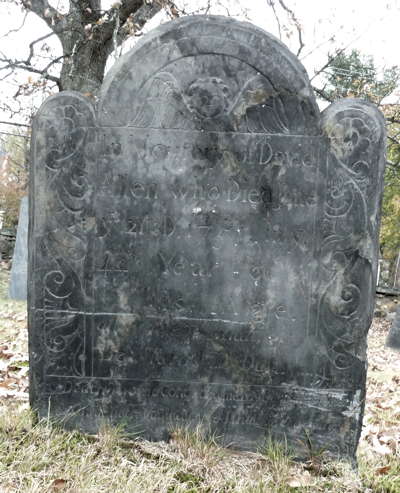
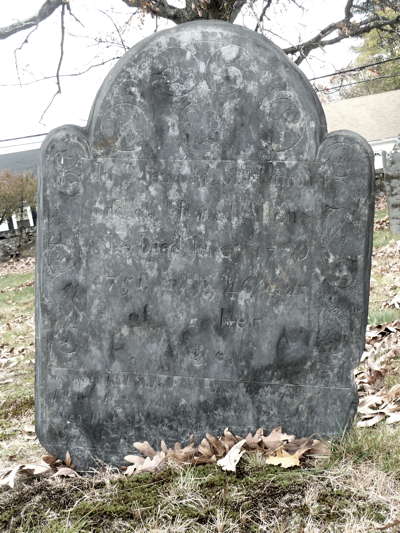
Today, almost eight years later, I finally visited Carolyn. My wife’s grandmother Carolyn Harmon Scott, née Carolyn Ayer Harmon, died in the year our oldest daughter was born, so she lived to see her first great-grandchild. Their first visit was when Cassandra was four days old—
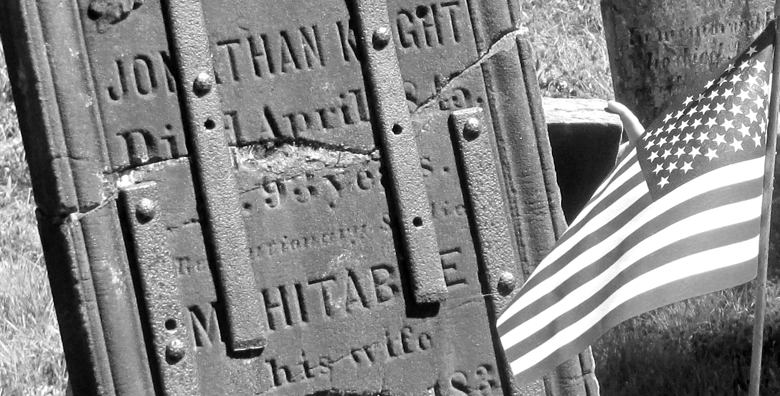
— but within a year, as Carolyn was at the end of her life, Cassandra got to play among the oxygen tubing that ran about her bed. Carolyn died 27 December 2000, while we were living in Kentucky. Mount Auburn Cemetery is lovely, and it did not take long to find my way to the Nye - Scott plot, somewhere between Mary Baker Eddy and Oliver Wendell Holmes. The small, unassuming plot dates from 1859 when David Charles Nye bought it to bury his own son, Carolyn’s husband’s great-grandfather Charles Ruggles Nye (1831-59). The oldest marble stone, probably erected to the son Charles Ruggles Nye, is now illegible but a closely matching one still legibly marks David C. Nye himself, who died in 1870.
(Continued)
Saturday, November 1, 2008
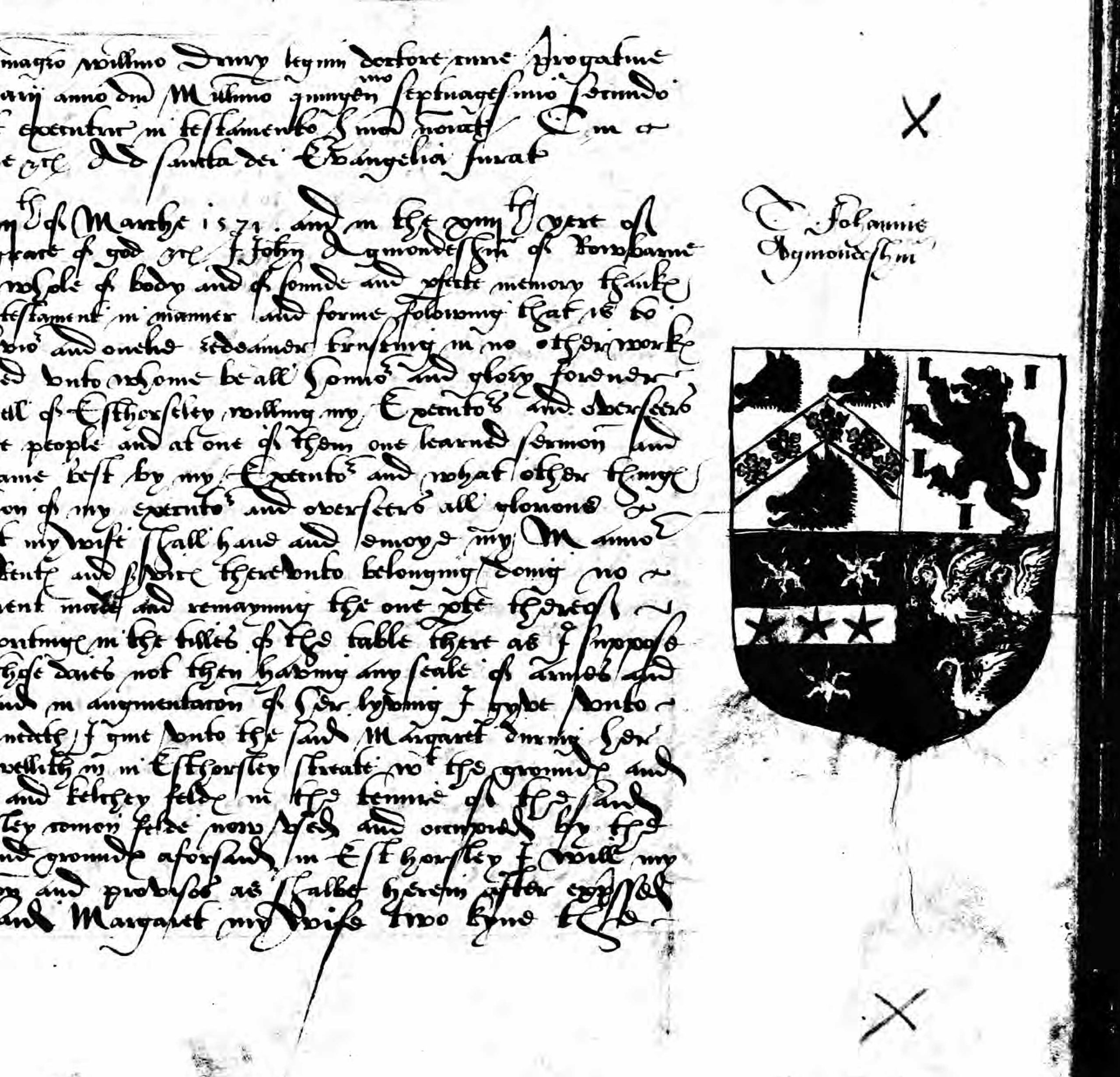
Yesterday, in the R. Stanton Avery Manuscript Collection of the New England Historic Genealogical Society (NEHGS) in Boston, I had the chance to look at (and, with the acquiescence of Timothy Salls, the manuscript curator, take a couple of photographs of) the Promptuarium armorum, a heraldic miscellany by William Smith, Rouge Dragon Poursuivant in the College of Arms from 1597 to 1618.
This manuscript’s title page says it was begun in 1602. It has long been known in New England heraldic circles; it belonged to John Gore and Samuel Gore, two heraldic and decorative painters, father and son, who created the ‘Gore Roll’ in the early or mid 18th century. The signatures of the Gores on the Promptuarium give it a strong provenance (though substantial gaps remain). It was in New England at least by the early 18th century, and in this regard is an important colonial document even though it is a book of English arms by an English herald.
I wonder whether anyone (at least here in New England) had previously noticed that the Promptuarium exists in two copies; the other is British Library MS Harley 5807. My purpose in visiting was to get some information about the Promptuarium with which to compare the Boston manuscript with that in London. (Continued)
Wednesday, October 22, 2008
I’ve finally made some progress on the family of my great-aunt Natalie, wife of my great uncle George A. Smith (born Schmitt) of Louisville and New York City. Smith, an actor on stage and screen, married Natalie, a New York socialite when they were both in their late 40s, during the war in 1944; they had no children.
Unc died before I was born but I well remember sitting in the back garden of Natalie’s townhouse on the Upper East Side on one overnight visit to New York. I was about five at the time (around 1970), and there is still a picture of me from that particular afternoon, with a great big bowl cut and my favorite loud striped pants. That afternoon I choked on a bullion cube; the next day when we went home I left my stuffed frog behind. Obviously the choke was not fatal, and Natalie later mailed the frog to me with a little note: “So glad to be home again.”
Anyway a couple of years ago I found out that Unc was in a movie that I could actually find on tape: ‘Stolen Heaven’ (1931). He has a small part and does a great comic routine with a cello. The place I got the tape from (a very dark nth generation bootleg) specialized in some weird porn and cult flicks; I’m not sure how this 30’s young love - crime melodrama fit into their catalogue. I started to look for examples of his TV work in the early 50s (he died in 1959), but don’t have any of the shows—preserved kinescope tapes of obscure early 1950s TV are rare, and these shows haven’t been collected on line yet, maybe never will.
Anyway, Natalie, who was born Natalie Slocum, has some interesting family connections. Her father, Henry Warner Slocum Jr., was a lawyer and sometime US tennis champion in the 1880s.
Her grandfather was Civil War general Henry Warner Slocum.
(Continued)
Wednesday, October 8, 2008
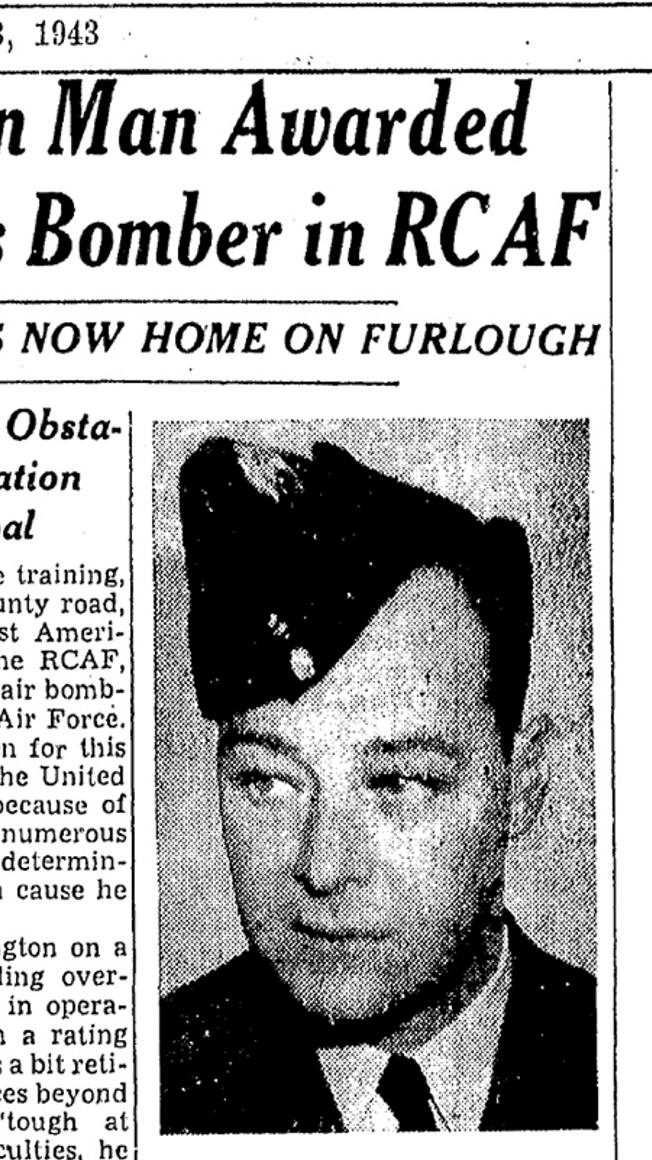
One thing that surprised me in the days following Sarah Palin’s emergence in September was the number of folks from among her base who did not recognize the pin she wore at the GOP convention and on her meet-world-leaders day at the U.N.: many wondered if she was wearing an Israeli flag pin, when actually it was a service banner, an emblem with a tradition established during WWI. Three service-banner items are found among the memorabilia in our family, including (I just recently found) a pin like that worn by Governor Palin.
(Continued)