Skip to content

Jack Allin of the 1st Rhode Island Regiment

Private Jack Allin
Freed from Slavery, 19 May 1777, to Enlist in
Capt. Thomas Cole’s Company, 1st Rhode Island Regiment.
Died of Disease at the Continental Army Cantonment
at Valley Forge, Pennsylvania,
18 May 1778
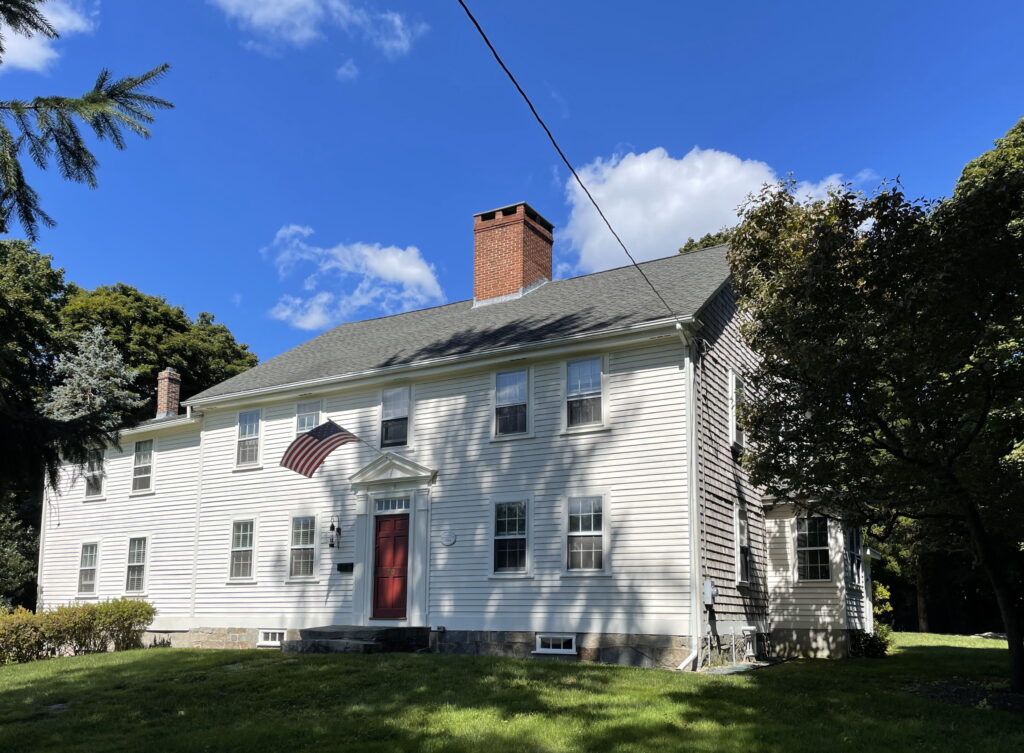

General Thomas Allin House, Barrington, Rhode Island

Nine years ago, in May 2017, while researching Civil War fatalities from Barrington, Rhode Island, in response to a Memorial Day request by Town Council present Mike Carroll, I learned that a young man who had lived in our Barrington house was killed in action in the Civil War: 2nd Lieutenant Joseph A. Chedel Jr., 1st Rhode Island Cavalry, killed at Middleburg, Virginia, 18 June 1863.[1]

This year, for America’s 250th, a similar request went out to research Barrington people who gave their lives in military service in the Revolutionary War. Working on this request, I learned that a second man from the same house lost his life on active military service. This man was a Revolutionary War casualty: Jack Allin of the 1st Rhode Island Regiment in the Continental Army.

Jack Allin was one of two men enslaved by the Allin Family who enlisted in the First Rhode Island Battalion (later called the First Rhode Island Regiment) in the Continental Army on May 19, 1777. Eight Barrington men enlisted that day to fill a town enlistment quota: a white officer (Ensign Simon Smith), a white sergeant, Enoch Jones, and six privates: a white man, Jonathan Andrews, a free Indigenous man, Joseph Sochorose, and four enslaved Black men, Jack Allin, Richard Allin, Thomas Reynolds, and Pomp Watson.[2]

Jack Allin and Richard Allin bore the surname of their enslavers, the prominent Allin family of West Barrington. As children, Jack and Richard had been slaves of Matthew Allin, who died in 1761, and are listed among nine enslaved people, only two of whom were adults, among the “Stock” — livestock — in Matthew Allin’s estate inventory, on 7 December 1761.[3]
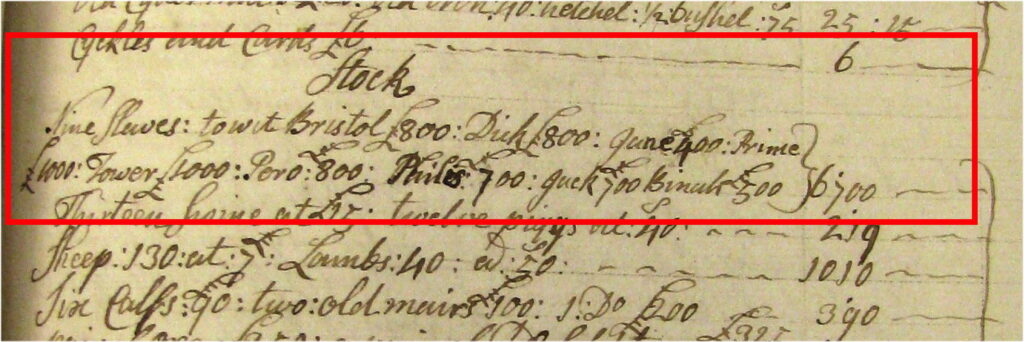

Jack, valued at £700, and Dick, valued at £800, in Matthew Allin’s estate inventory, 1761

Matthew’s two sons, Thomas and Matthew, divided up their father’s nine enslaved people along with the rest of the family estate. Records show that Richard was enslaved by Matthew Allin; Jack, therefore, was enslaved by Thomas Allin.[4] The Barrington men who joined the 1st Rhode Island Regiment on May 19, 1777, were all enlisted for a period of three years.

Jack and Richard served together in Capt. Thomas Cole’s company. The 1st Rhode Island left home in the summer of 1777, going first to New York and then to New Jersey, where they successfully engaged a superior force of Hessians at the battle of Red Bank (Fort Mercer), New Jersey, on October 22, 1777. In December, the 1st Rhode Island joined over twelve thousand Continental soldiers encamped with General Washington at Valley Forge, Pennsylvania.[5]

Jack Allin did not live to come home to Rhode Island. Reported as “sick,” but “present,” in Captain Cole’s company in April 1778,[6] Jack Allin was then listed in May in a detachment mostly of sick men, five of whom died that month. The roll shows Jack Allin as “Deceased May 18, 1778.”[7]
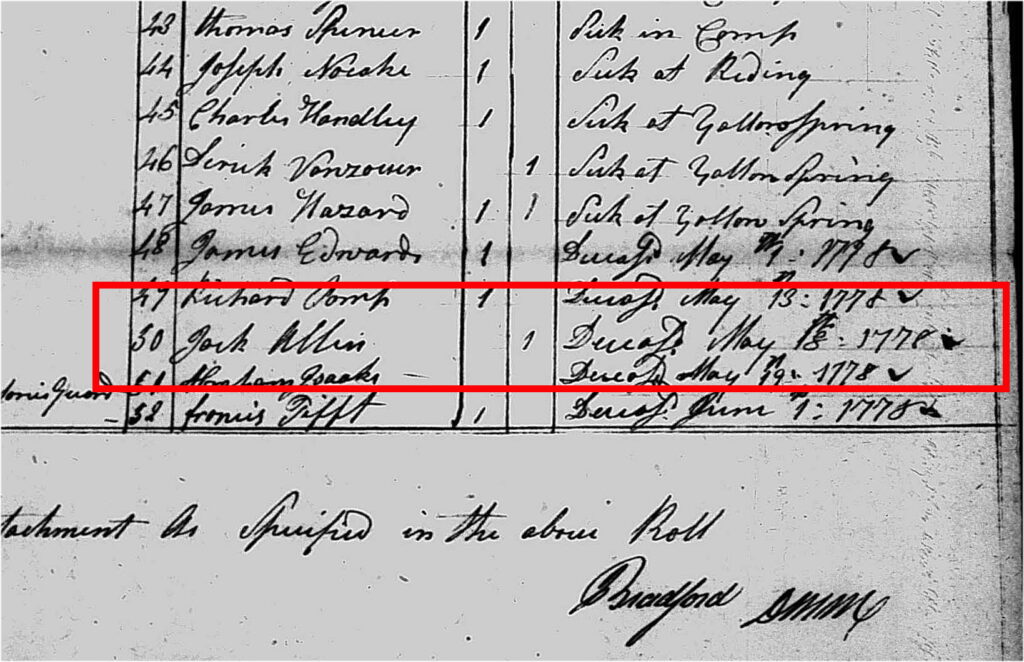

Jack Allin, deceased May 18th, 1778: Muster Roll entry

In his death, Jack Allin joined 1700 soldiers who lost their lives from disease, malnutrition, or exposure at Valley Forge in the harsh winter of 1777-1778. It is believed that most were buried in unmarked graves in different locations in the vicinity of the Valley Forge cantonment.[8]

After his death, Jack Allin’s story is closely intertwined, in the records, with that of his fellow-slave and fellow-soldier Richard Allin.

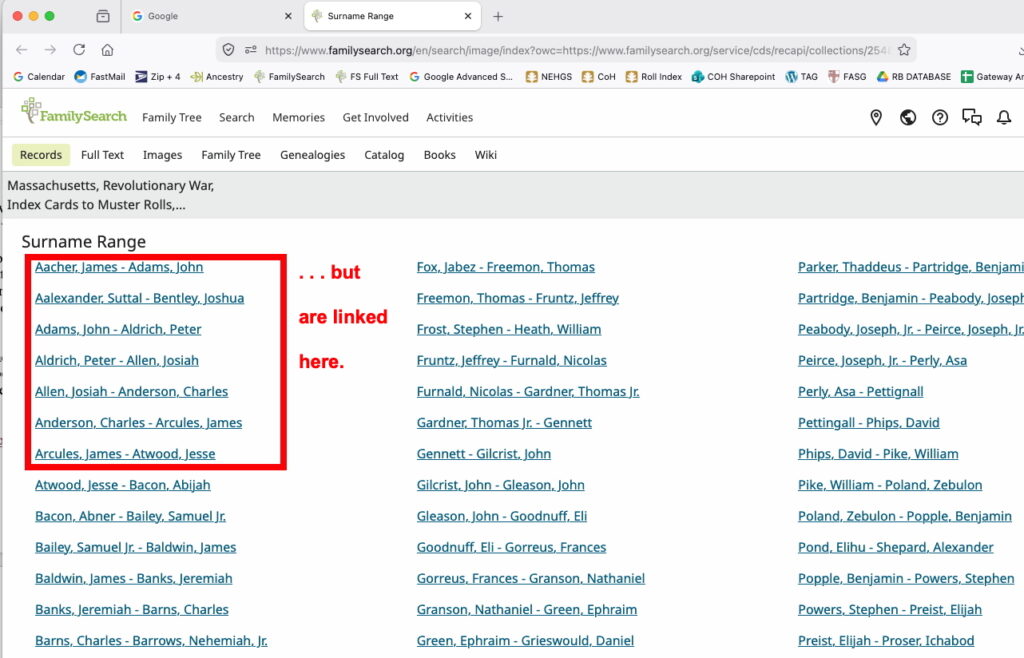
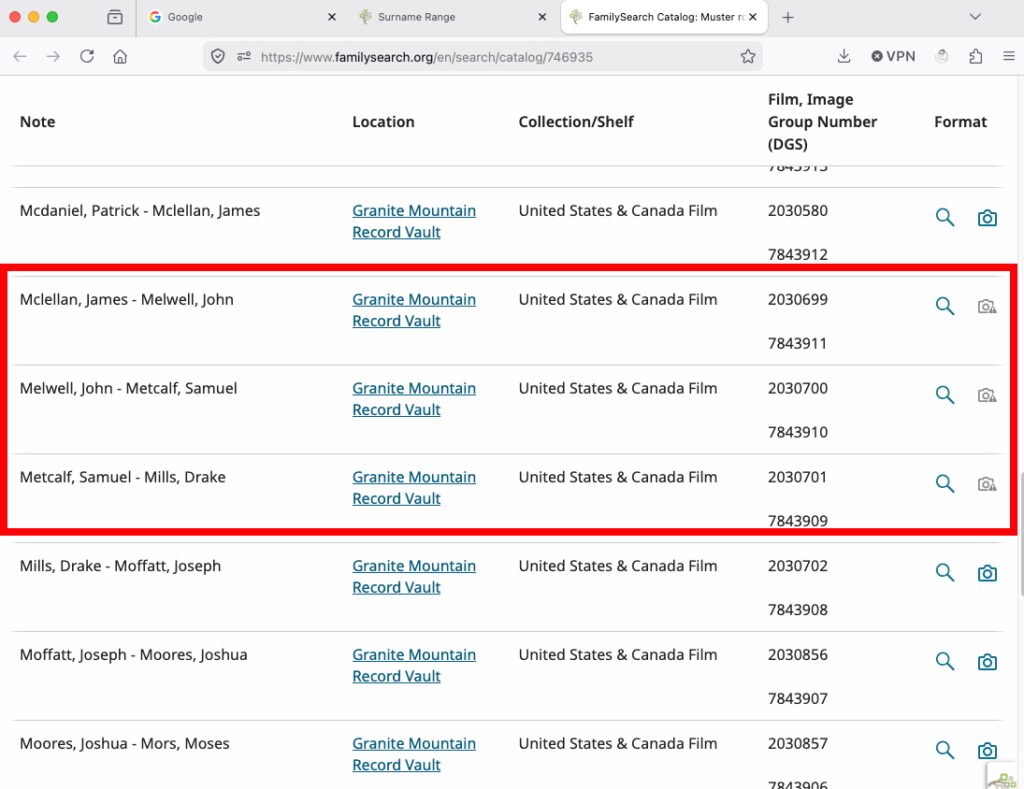
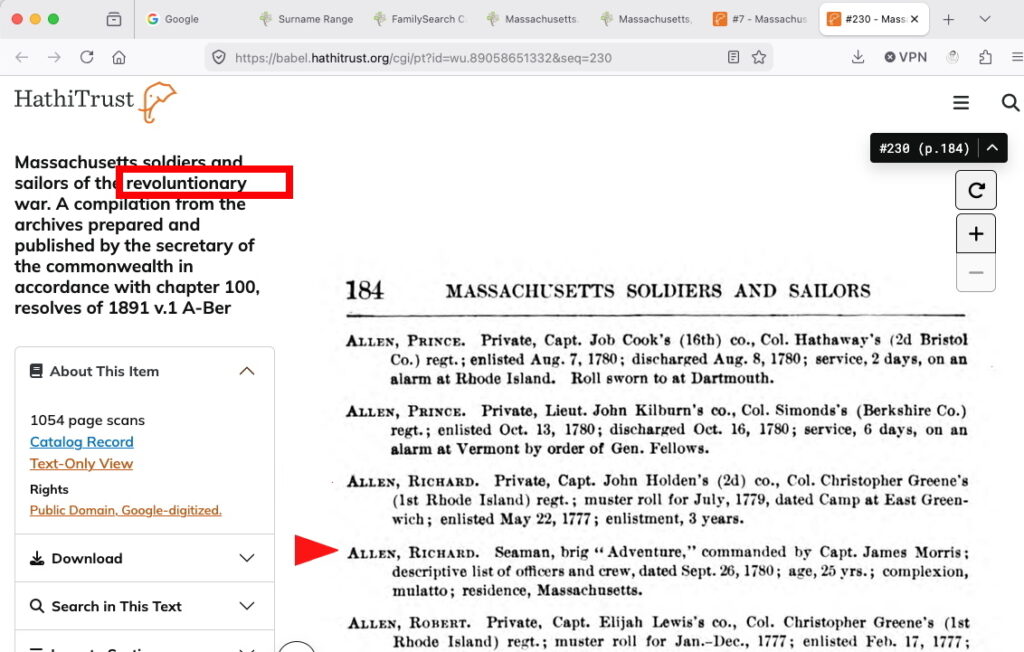
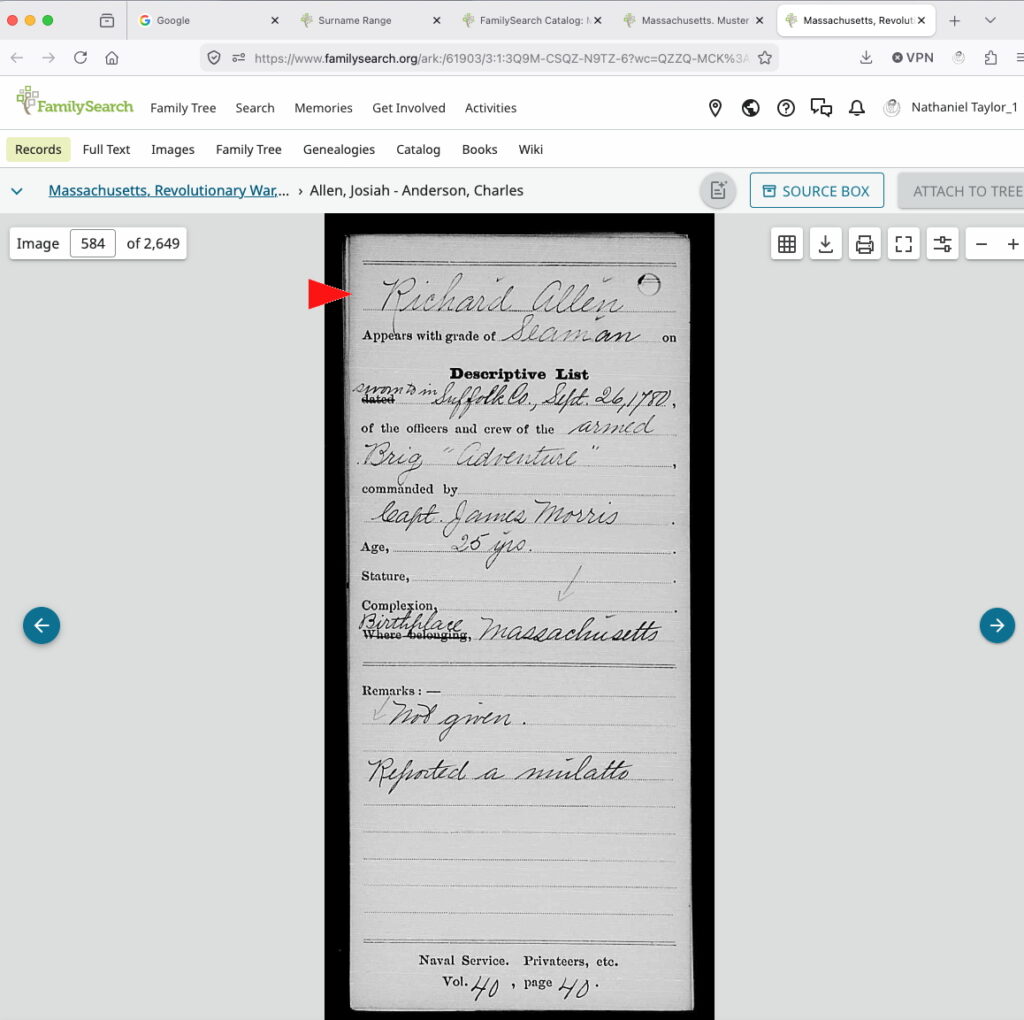
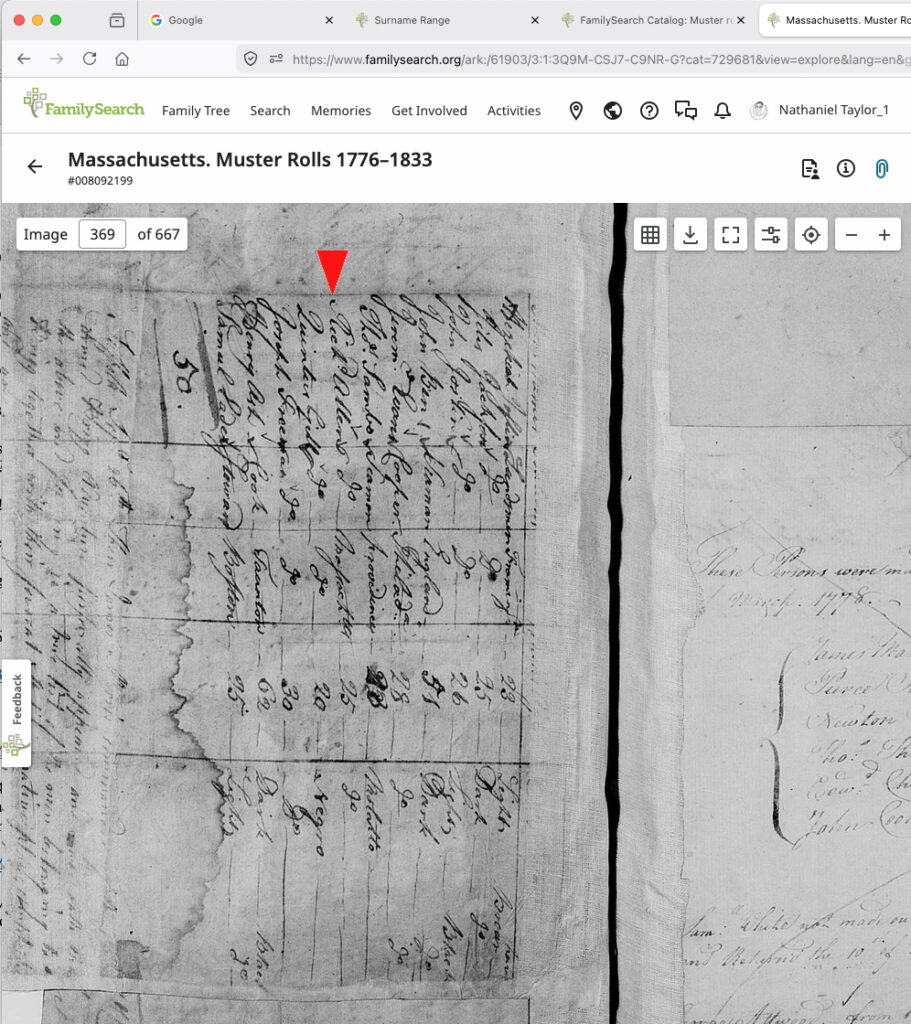
Richard Allin survived Valley Forge and the Battle of Rhode Island in August 1778, then served out his three-year enlistment until May 1780. He then went to sea on two privateer vessels out of Boston: the ship Tracey in July 1780 and the brigantine Adventure, where he was listed as “mulatto,” age 25, in the ship’s muster of 26 September 1780.[9], meaning that he had been about six years old when valued at £800 in Matthew Allin’s 1761 estate inventory.
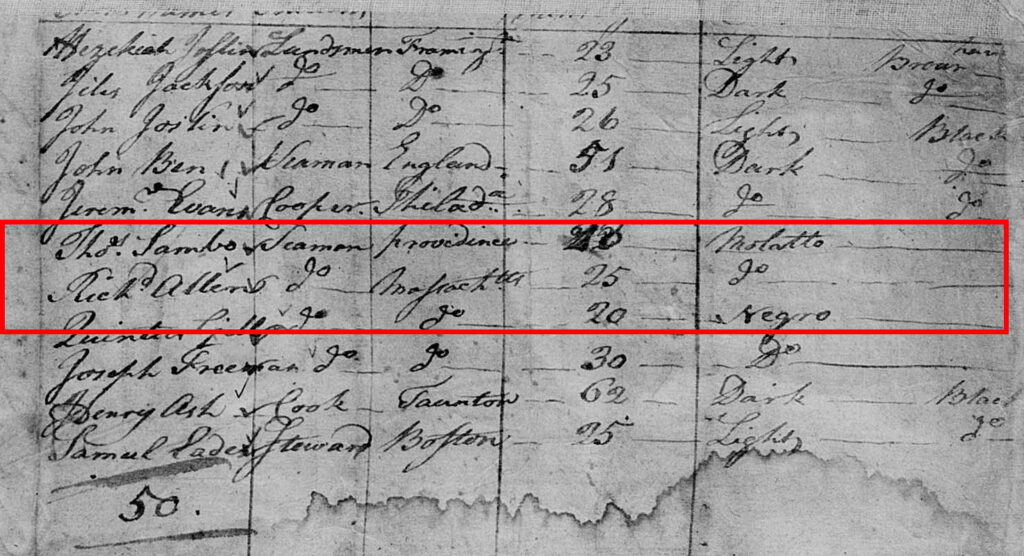

Richard Allin in Muster Roll of Brigantine Adventure, 26 September 1780

It is not known whether Richard was on active service on a privateer at the time of his death, but Richard died about a year after joining the crew of Adventure. On 7 January 1782, Captain Thomas Allin was granted administration of the estates of “Jack Allin a free negro late of Barrington, deceased” and also of “Richard Allin a free negro man late of Barrington, deceased.”[10] Both Jack and Richard Allin were entitled to back pay from their service in the 1st Rhode Island Regiment. Richard, in addition, was owed prize money from his cruises on Tracey and Adventure. Jack Allin left no kin appearing in his estate records. Richard Allin, however, had married Patience Laurence, an Indigenous woman, who sought his remaining shares of the privateers’ earnings in a brief dated 26 February 1782.[11]
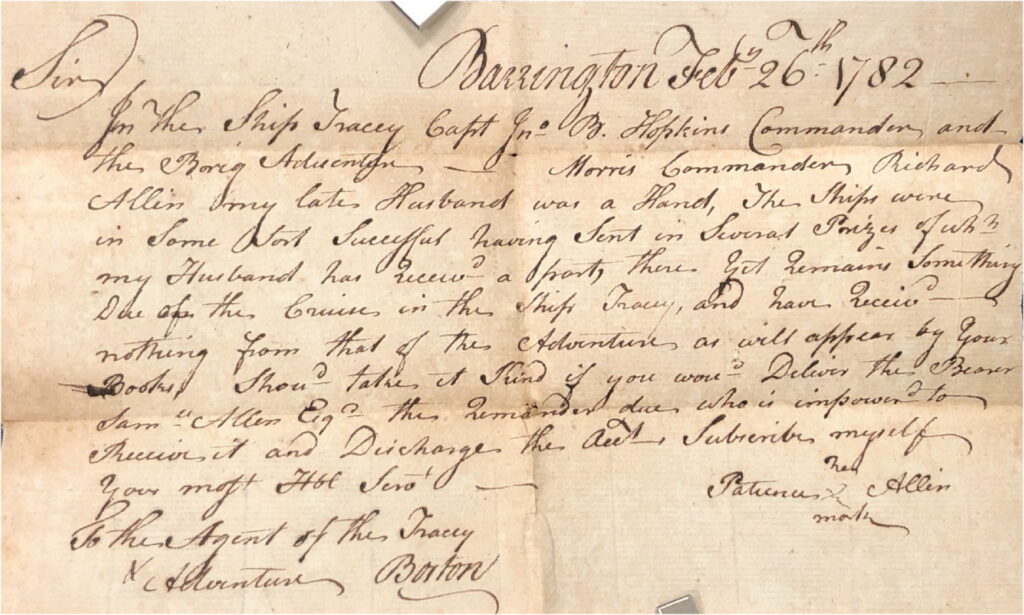

Richard Allin’s widow, Patience Allin, seeks his prize money from two privateer ships

Estate administration for Jack Allin and Richard Allin dragged on. The estate file does not mention Richard Allin’s prize money after 1782, let alone whether any of it was recovered by his widow, Patience. By March 1797, the estate of Jack and Richard consisted only of “certificates of depreciation” relating to unpaid wages in the 1st Rhode Island Regiment. Richard’s certificate of depreciation for £74 18s. 10d. was then valued at $150. A certificate of depreciation for Jack Allin’s back wages in the amount of £18 13s. 2d. had at some prior point “been fraudulently taken out of the general treasury by a person unknown”; any expectation of his wages was therefore valued at only $10.[12]
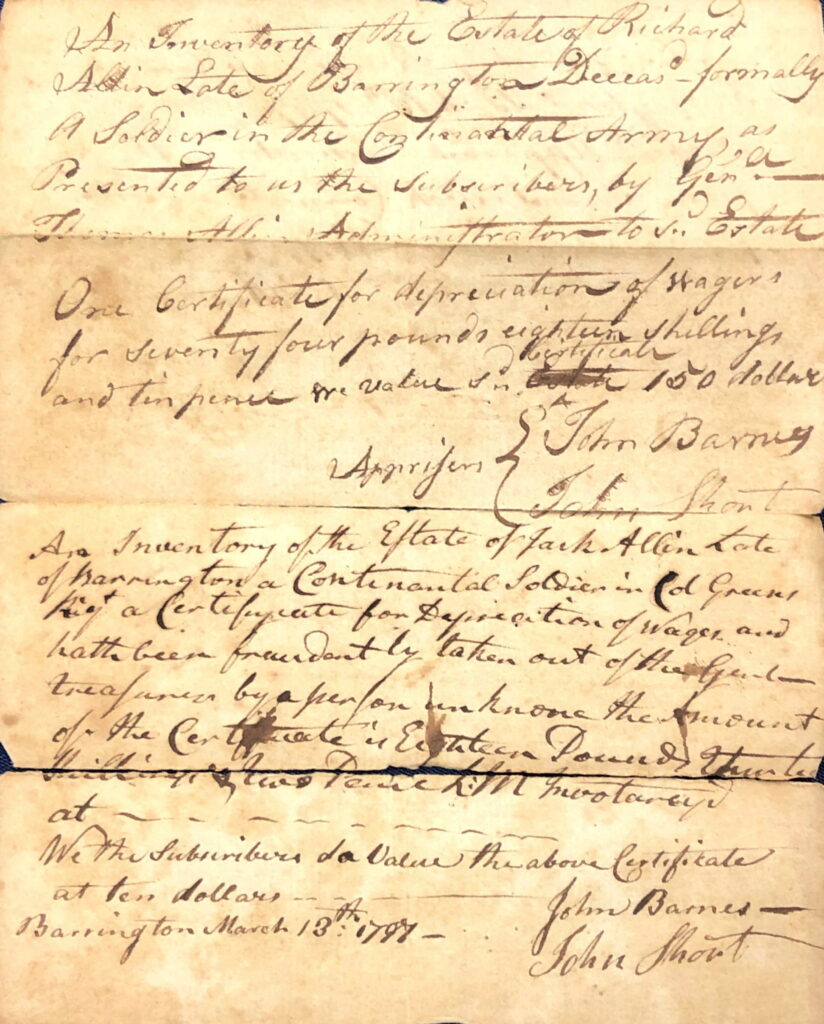

Valuations of back pay owed to Jack Allin and Richard Allin, 13 March 1797

Thomas Allin, Jack’s former enslaver and the administrator of Jack’s and Richard’s estates, was by then a general in the Rhode Island militia system. General Allin did not settle their estates before his own death in 1800; his widow, Amy, was called to account about it. Jack’s and Richard’s estates were finally closed on 4 February 1805, when town commissioners determined that all potential back wage claims had been exceeded by administrative costs of the case.[13] No kin of either man received a penny. This concluded a long postscript to what, in Jack’s case, had been only 364 days of military service.

A few years ago, while researching other Barrington houses for plaquing by Barrington Preservation Society, I conceived the idea of Gold Star Houses — whose occupants gave their lives in military service. It seems to me this is a thing worth remembering about people and their houses in our communities, just as Gold Star Families are and should be honored.[14]

Only now have I realized our Barrington house, the General Thomas Allin House, which is now on the National Register of Historic Places [15] and was built apparently between 1769 and 1774, is a double Gold Star House — through Lt. Joseph A. Chedel Jr. in 1863 and also, we now know, through Jack Allin in 1778.

Today is the 248th anniversary of Jack Allin’s death at Valley Forge.


[1] Nathaniel Taylor, “Joseph A. Chedel, Civil War casualty,” A Genealogist’s Sketchbook (blog), 29 May 2017.
https://nltaylor.net/sketchbook/archives/2212
Nathaniel Taylor, “Joseph A. Chedel Jr’s Gravestones,” A Genealogist’s Sketchbook (blog), 30 May 2017.
https://nltaylor.net/sketchbook/archives/2223

[2] Thomas W. Bicknell, History of Barrington, Rhode Island (Providence, 1898), 364-365, extracting from the first volume of Barrington Town Council records.
https://archive.org/details/historyofbarring00bick/page/364/mode/2up

[3] Warren, Rhode Island, Probate Act Book 2:236-237 (all of what is now Barrington, R.I., was part of Warren, R.I., from 1747 to 1770).
https://www.ancestry.com/imageviewer/collections/9079/images/007649150_00133 (FHC-locked).
That only two of the nine were adults is implied by Matthew’s will, dated 28 April 1761, in which he empowered his executrix (his wife, Ruth) to “sell any or either of my upgrown slaves if they be disobedient or of any ill behavior” (Warren, Rhode Island, Probate Act Book, 2:224-227). The inventory does not describe the color or ethnicity of the enslaved people, but Matthew’s will mentions that Ruth is to choose one female “negro” slave as her bequest. Richard (“Dick”) is described in one later document as “mulatto” (see below).

[4] Matthew and Thomas Allin each received a state bounty payment of £44 for Jack Allin and Richard Allin’s enlistment. The record of Richard Allin’s marriage, included in his estate file, states that Richard was “late a slave to Capt. Matthew Allin”; Jack, therefore, was enslaved by Thomas (Barrington, R.I. Estate File Papers, Old ser., no. 50 [not online]).

[5] Daniel M. Popek, They “Fought Bravely, But Were Unfortunate:” The True Story of Rhode Island’s “Black Regiment” (AuthorHouse, 2015).
https://books.google.com/books?id=HMnyCgAAQBAJ

[6] Muster Roll, Thomas Cole’s Co., 1st R.I. Regiment, Month of [April] 1778, “Revolutionary War rolls 1775-1783,” NARA Record Series M246, Roll 85: Rhode Island jackets (roll 1 of 4 for R.I.), FS DGS 004171621, Image 256/814.
https://www.familysearch.org/ark:/61903/3:1:3QSQ-G9WB-QW5N

[7] Muster Roll, “detachment” [Capt. Thomas Arnold], 1st R.I. Regiment, May 1778, “Revolutionary War rolls 1775-1783,” NARA Record Series M246, Roll 85: Rhode Island jackets (roll 1 of 4 for R.I.), FS DGS 004171621, Image 129/814.
https://www.familysearch.org/ark:/61903/3:1:3QS7-89WB-Q4KR

[8] Wayne Bodle, The Valley Forge Winter: Civilians and Soldiers in War (Penn State Univ. Press, 2002).

[9] “Muster rolls of the Revolutionary War, 1767-1833,” Massachusetts State Archives, SC1-57x, 75 vols., vol. 40 (Naval service, privateers), sheet 40, dorse (FamilySearch 8092199, Image 369/667).
https://www.familysearch.org/ark:/61903/3:1:3Q9M-CSJ7-C9NR-G
He is listed as of “Massachusetts,” but the papers in his estate file leave no doubt this is the Barrington man.

[10] Barrington, R.I., “Probate and Council 1777–1818” [i.e., Town Council minute books, vol. 2], page 45.
https://www.ancestry.com/imageviewer/collections/9079/images/007649156_00075

[11] Barrington, R.I. Estate File Papers, Old ser., no. 50, estate of Jack Allin and Richard Allin: both the brief (pictured here) and a note with same date by Solomon Townsend, Town Clerk, attesting that Allin and Laurence had been lawfully married by him.

[12] Original note in Barrington Estate File Papers, Old ser., no. 50. Recorded in Barrington “Probate and Council 1777–1818” [i.e., Town Council minute books, vol. 2], p. 239.
https://www.ancestry.com/imageviewer/collections/9079/images/007649156_00177

[13] Barrington, Probate Acts “Book 3, 1798–1808” (i.e. vol. 1 of series independent of Town Council recs.), pp. 109-110 (not filmed by FamilySearch).

[14] Nathaniel Taylor, “Gold Star Houses,” A Genealogist’s Sketchbook (blog), 13 September 2023.
https://nltaylor.net/sketchbook/archives/1985

[15] Nathaniel Taylor, “Thomas Allin House on the National Register of Historic Places,” A Genealogist’s Sketchbook (blog), 13 September 2023.
https://nltaylor.net/sketchbook/archives/2246

A Revolutionary Casualty: Peter Lurvey

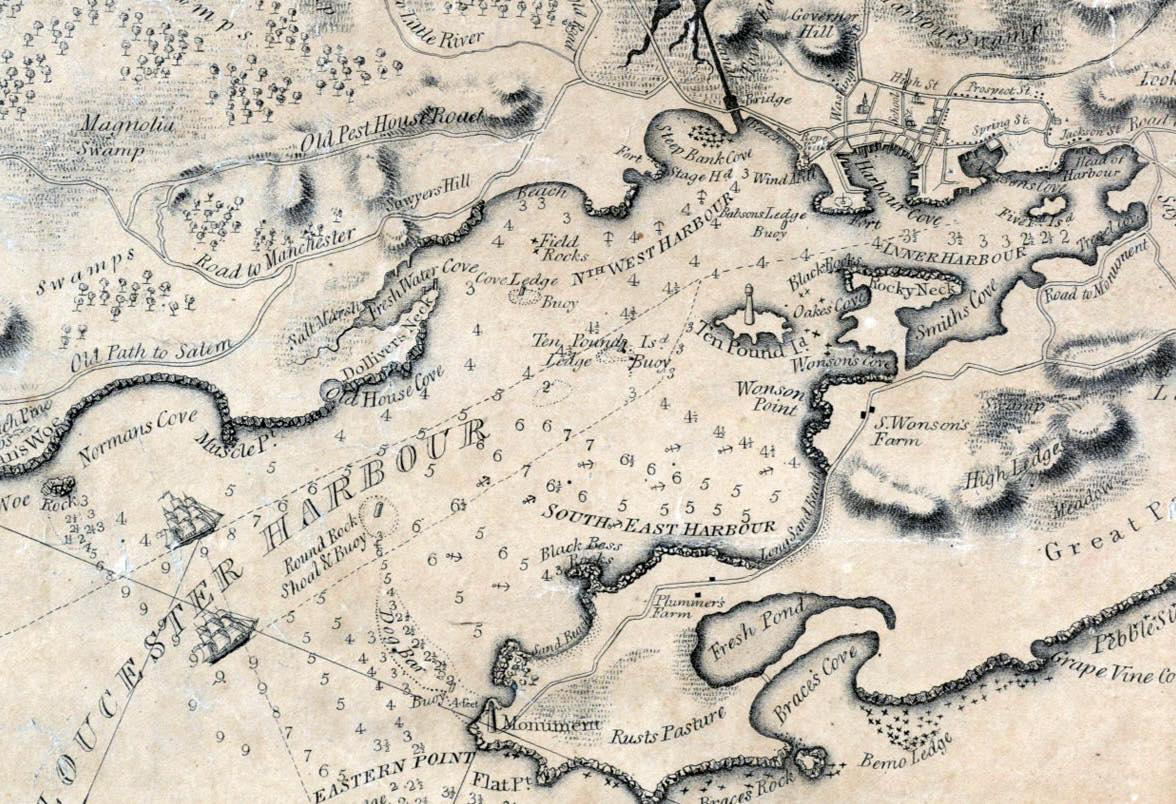
August 8, 1775 — 250 years ago this day — a Gloucester, Massachusetts, militia company scrambled and successfully fought off a shore raid by marines from HMS Falcon, menacing Gloucester Harbor. Dogtown resident and militiaman Peter Lurvey, age 35 — my ancestor — was fatally shot, dying later in the day. He is my only (known) Revolutionary War ancestor killed in action.

My mother’s cousin Janet was in the DAR as a Peter Lurvey descendant. A photocopy of her lineage paper was my first introduction to genealogy — about 40 years ago. The odd twist that we descend from Peter Lurvey *twice* got me even more curious about all this stuff.

Detail of “Gloucester Harbour” from “Map of Gloucester, Cape Ann” from survey by John Mason, printed by Senefelder Lithographic Co., Boston, in 1831, available at the Library of Congress and the Leventhal Map Center at Boston Public Library.

A whole book contextualizing the Battle of Gloucester is Joseph Garland’s The Fish and the Falcon: Gloucester’s Resolute Role in America’s Fight for Freedom (2006). There’s a recent webpage at HistoricIpswich.net (using the same map illustration) here.

A Bunker Hill Conundrum: William Grimes of Gloucester

Two companies of men from Gloucester, Massachusetts, fought at the Battle of Bunker Hill, 250 years ago today: Captain Nathaniel Warner’s company in Col. Moses Little’s 17th Regiment, and Capt. John Row’s company in Col. Ebenezer Bridge’s 11th Regiment.[1] Both companies have muster rolls and related documents surviving in the Massachusetts State Archives. One of the men in Capt. Warner’s company was William Grimes. Was he my ancestor?  Probably, but I am not sure. It is one of those cases where evidence includes enough conflict to cast doubt. How much doubt?

My ancestor William Grimes was the only adult of that name (so it seems) living in Gloucester from early adulthood in the 1760s through 1789. Then there were two of them, father and son, in the censuses and tax lists of 1790, 1798, and 1800, after which the father died probably before 1810 and the son left Gloucester. The surname Grimes (or Graham, or Grimes alias Graham) had first appeared in Gloucester with Andrew Grimes who married Mary Davis in 1731. They had five children from 1731 to 1745, three daughters and two sons, Andrew in 1739 and another, born in 1745, but with no given name in the record—presumed to be William who, alongside the 1739 Andrew, appears as an adult in the next generation. In 1765 William Grimes married Abigail McLaughlin; they had five children between 1766 and 1782. But three years before marrying, William Grimes in 1762 was recorded in town as the father of an illegitimate child. (This illegitimate child, Lydia, is my ancestor.) It is plausible that William Grimes was the unnamed boy born in 1745, fathering an illegitimate child at age 17 in 1762, and marrying three years later at age 20.

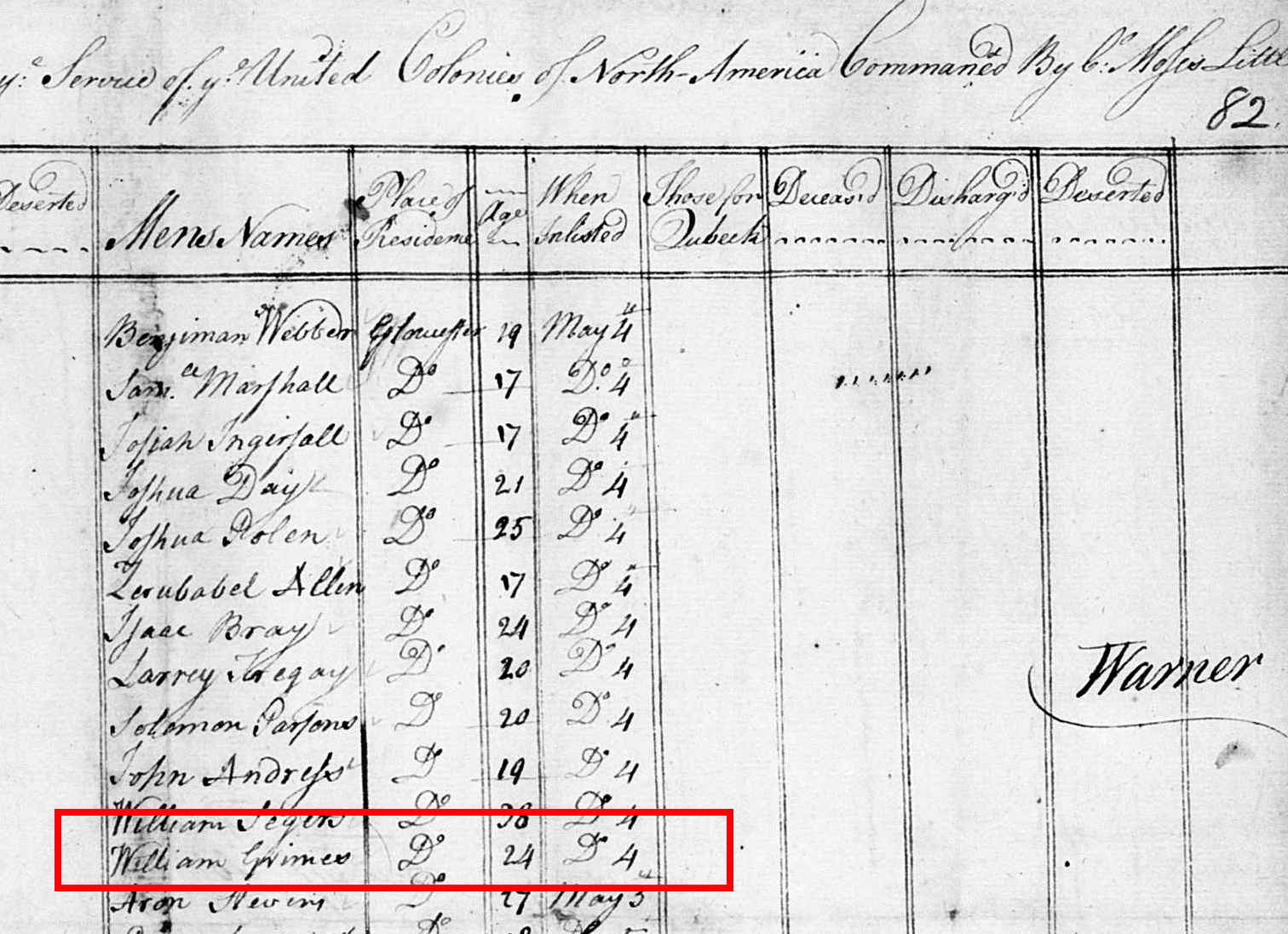
The Revolution, however, presents a problem. Two rolls of Capt. Nathaniel Warner’s company survive from summer and fall of 1775. One lists all the soldiers’ ages, in years. William Grimes was “24”– suggesting birth about 1751, which would have made him an absurdly young husband at age 14 in 1765, and stretching credulity to the breaking point to have fathered a child at age 11 or 12 in 1762.

It is worth remembering that we do not know for certain that the William Grimes who married in 1765 and fathered a child in 1762 was the unnamed son of Andrew and Mary Grimes born in 1745. He could have been born some other time, earlier or later — but probably not much later. Or he could have been related to this earlier Grimes couple some other way, or not at all.

But Occam’s razor suggests that we give weight to the absence of any (other) evidence pointing to two near-contemporary William Grimeses, and consider the probability that we are dealing with one William Grimes, who was the child of Andrew and Mary, became a father in 1762 and married in 1765, and was also the soldier in Capt. Warner’s company — and that his stated age in the muster is an error, understating his age by five years (or some other amount). John Bradley Arthaud and Ernest Hyde Helliwell III considered this problem and concluded that it was most likely that the muster roll age was in error.[2] But their conclusion was based only on seeing the age in a printed source, the entry for Grimes in Massachusetts Soldiers and Sailors of the Revolutionary War.[3] They went on to suggest, “If the printed ’24’ is a mistake for an original handwritten ’29’, then a birth year of ca. 1744 would correspond favorably to our William’s birth in 1745.”

But the original roll (from which the Soldiers and Sailors reference was drawn) clearly shows “24”:[4]

This eliminates a manuscript-to-print transcription error, but still leaves open the possibility that this muster roll itself, perhaps a fair copy from other draft lists, might include a transcription error. More due diligence is required before accepting that this is the same William Grimes. Specifically: a new “reasonably exhaustive” review of Gloucester sources to confirm the absence of any evidence suggesting the sojourn of a second contemporary William Grimes in Gloucester; and also, perhaps, a systematic review of the stated ages of other men in the muster to assess its accuracy and consider analogous errors.

I have not yet done either portion of this due diligence to my satisfaction. But—thinking about William Grimes on the anniversary of the Battle of Bunker Hill—it needs to be done!


[1] “1775: Battle of Bunker Hill,” post from “The Gloucester Timeline:  An Interactive History,” at website of Sawyer Free Library, Gloucester (https://timeline.sawyerfreelibrary.org/timeline/battle-of-bunker-hill/).

[2] John  Bradley  Arthaud  and  Ernest Hyde Helliwell III, “The  Mark3 and  Tammy  Lurvey  (Priestley)  Grimes  Family  of Gloucester  and  Rockport,” The Essex Genealogist 29 [2008]: 121–32, 159–69, at 122 note 20.

[3] Massachusetts Soldiers and Sailors of the Revolutionary War, 17 vols. (Boston, 1896-1908), 6:898.

[4] “A list of Capt. Warners Company in the 17 Regt of Foot in the Service of the United Colonies of North America Commanded by Col. Moses Little” tipped in as document #82 in vol. 56 of “Muster Rolls of the Revolutionary War, 1767–1833” (77 vols. in 81), Massachusetts State Archives, Collection SC1-57 [FamilySearch DGS 8092211, image 184/476].

250 years ago this day — Samuel Harmon’s commission

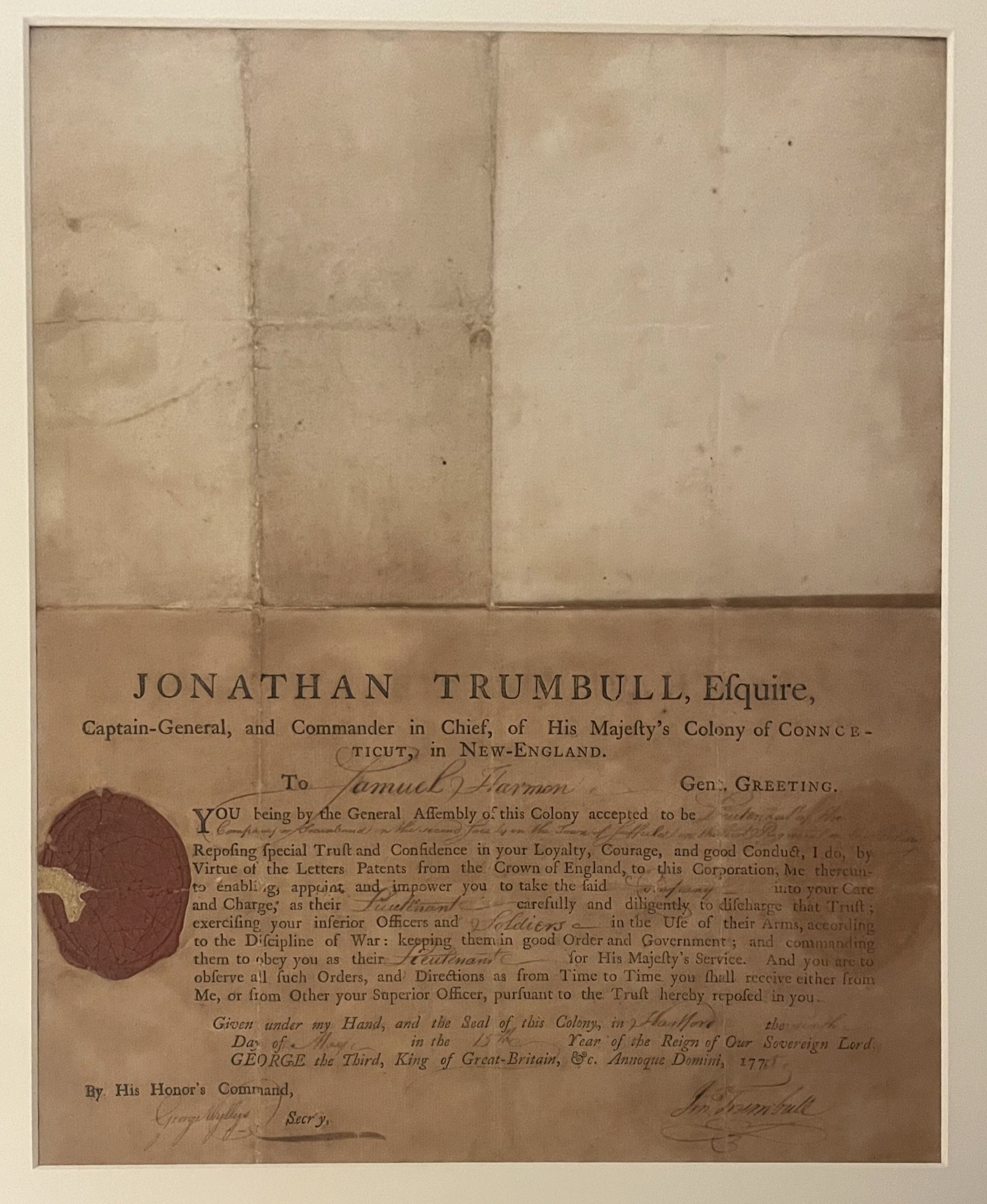
250 years ago today — May 6, 1775 — Julie’s ancestor Samuel Harmon was commissioned as lieutenant of the militia company of the “Second Society” of the town of Suffield in “His Majesty’s Colony of Connceticut in New-England,” by its Governor, Jonathan Trumbull. There is indeed a typo in “Connecticut”.

A fortnight after the Lexington alarm, militias were expanding. The “Second Society,” the second Suffield church, formed in the western part of the town, dated back to 1744, but I don’t know if it had its own militia company before this moment.

In 2006 we had this folio sheet conserved and reframed in its full, unfolded state, which emphasizes just how Lt. Harmon folded and carried it.

Thomas Allin House on the National Register of Historic Places

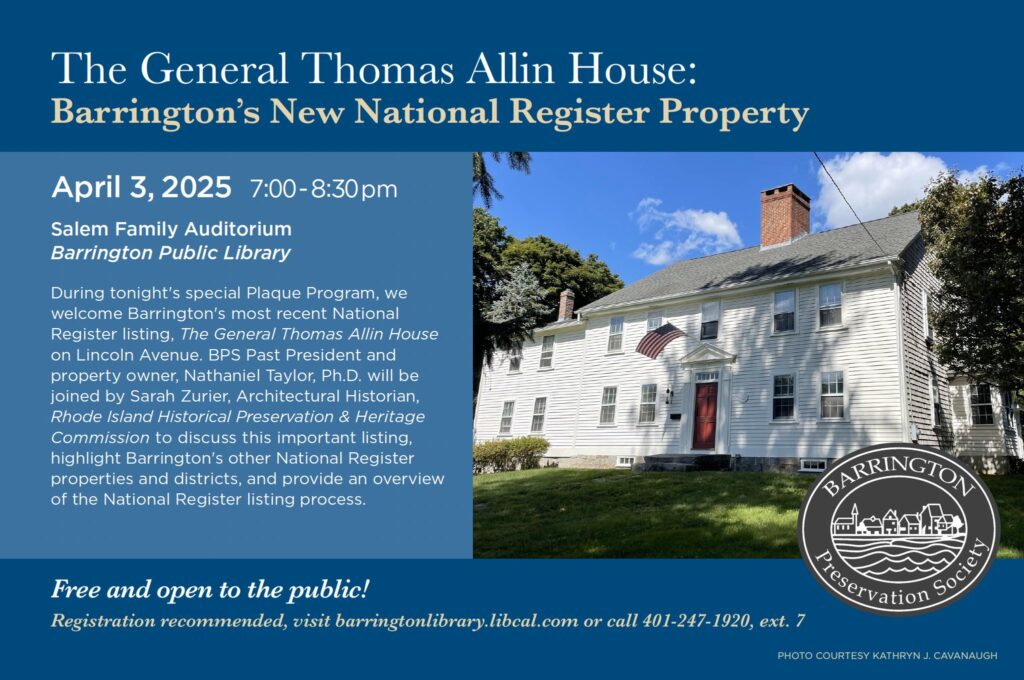
Our house in Barrington, RI, was listed on the National Register in February, 2025. On Thursday, April 3, 2025, I was joined by Sarah Zurier of the Rhode Island Historical Preservation & Heritage Commission at the Barrington Public Library. Together we shared homeowner/researcher and state perspectives on this house, the National Register, and the value of researching and recognizing landmarks in our communities.

The General Thomas Allin House is now listed among the National Register properties on the website of the Rhode Island Historic Preservation and Heritage Commission. The complete dossier (145 pages) can be downloaded there. 

One of the Allin House’s criteria of significance is the role of the property in the history of slavery in the community. The first documented involvement of the owners of this farm with slavery was in 1704 when the grandfather of the man who built this house purchased an African boy, Felix — from an ancestor of mine.

The 2nd of July

As we approach the quarter-millennium of the Revolution, the 4th of July looms large.

But on July 2, I think of Gettysburg.

(In addition to my late brother, Marvin, for this would have been his 64th birthday.)

Our grandfather’s grandfather George Washington Lane of Gloucester, Massachusetts, was there as a soldier in the 32nd Massachusetts Infantry, part of Col Sweitzer’s brigade (2nd Brigade, 1st Div., 5th Corps) in the Army of the Potomac. At first held in reserve, on the afternoon of July 2, 1863 (the second day of the battle), this brigade fought at the “Wheatfield”:

“[T]he Brigade advanced to the support of First Division Second Corps and engaged Brig. Gen. Anderson’s Brigade at the stone wall at the south end of the Wheatfield but the supports on the right having given away the Brigade was attacked on the right and rear and it retired under a heavy fire to a line north of Little Round Top.”

“Casualties: Killed: 6 Officers, 61 Men; Wounded: 26 Officers, 213 Men; Captured or Missing: 1 Officer, 120 Men; Total 427.”

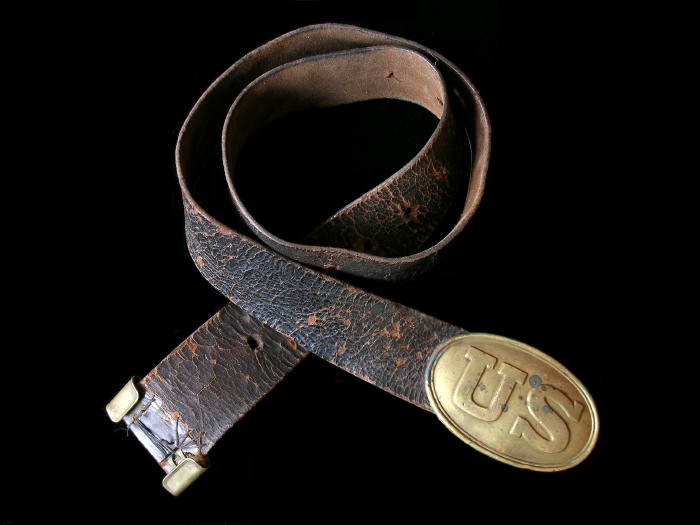
(Quotation from the 1910 bronze brigade tablet at Gettysburg. Photo: my grandfather’s grandfather’s belt.)

Recent addition to a Charlemagne bookshelf

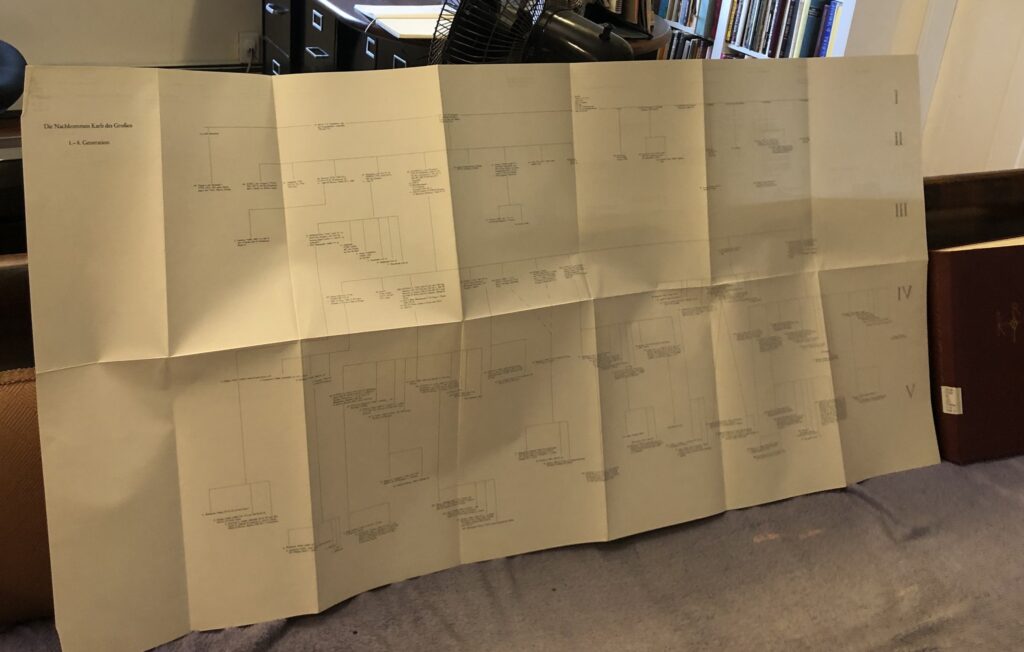
Recent addition to a Charlemagne bookshelf: huge pedigree of all known descendants of Charlemagne through eight generations, roughly to the year 1000. This side, generations 1-5; other side, generations 6-8, so you need two copies if you want to display it!

Published in 1967, with 79 pp. of dense and, for some lines, still-definitive annotation, in a four-volume interdisciplinary conference proceedings / reference set on Charlemagne (Karl Ferdinand Werner, “Die Nachkommen Karls des Grossen bis um das Jahr 1000: 1-8 Generation,” in Karl der Grosse: Lebenswerk und Nachleben, 4 vols. [Düsseldorf, 1965-68], 4:403-82).

Once a reference-room staple in university libraries, discarded copies now occasionally available. This one came from University of Arizona. Not available digitally anywhere, so far as I know.

Anna Julia Cooper and the Pilgrimage of Charlemagne

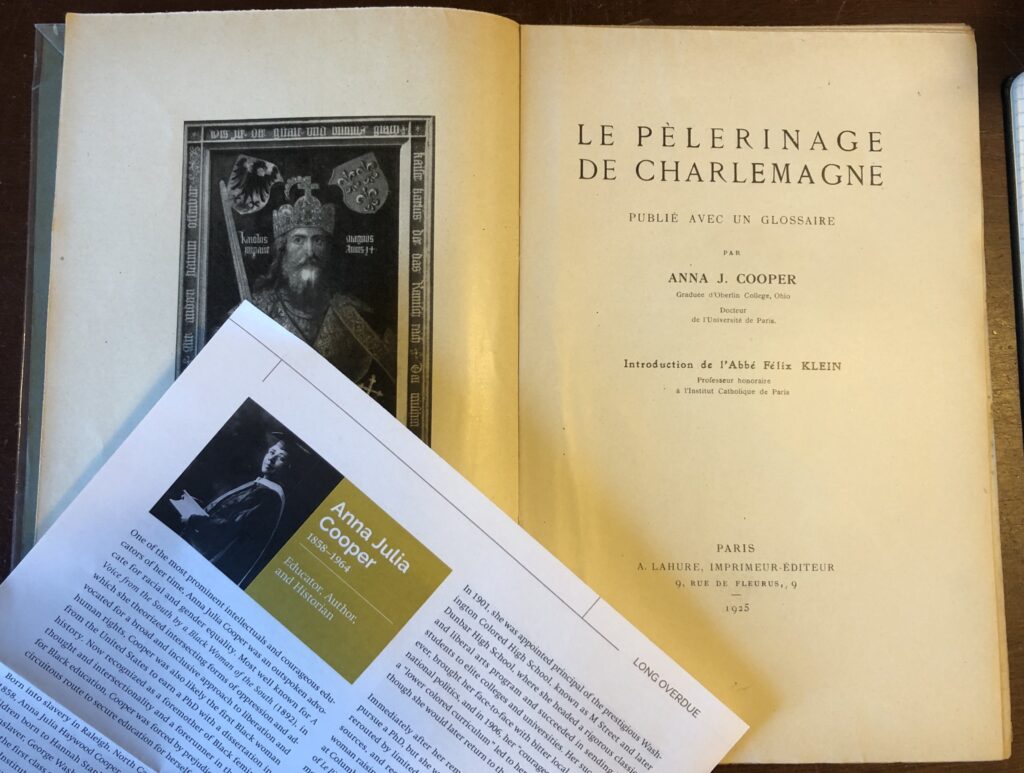
Delighted to see a page about Anna Julia Cooper (1858-1964) in this month’s Perspectives on History (magazine of the American Historical Association, now very ably edited by a former student, Leland Grigoli). I cherished Dr. Cooper’s 1925 edition of the 12th-century chanson de geste “Le pèlerinage de Charlemagne” (“The Pilgrimage of Charlemagne”) for years before knowing anything about her.

Born into slavery, she is the first African American woman to receive a PhD in history — which she did from the Sorbonne, at age 67, in the middle of a long, distinguished career as an educator: she lived to the age of 105. I think of her as a medievalist, but her previous degrees were in math, and her doctoral dissertation was on French attitudes towards slavery in the 18th century.

Through the family of her enslavers — specifically, one of the two Haywood brothers who have been suggested as candidates for her paternity — a line could traditionally be traced from Dr. Cooper to Charlemagne through alleged gateway ancestor Ensign Thomas Savage (d. by 1633) of Accomack Co., Virginia. He had been supposed to have descended from a gentry Savage family with known baronial and royal ancestry — but there is no evidence to support this old guess. Nevertheless, Dr. Cooper’s own descent from Charlemagne is a statistical certainty.

Gold Star Houses

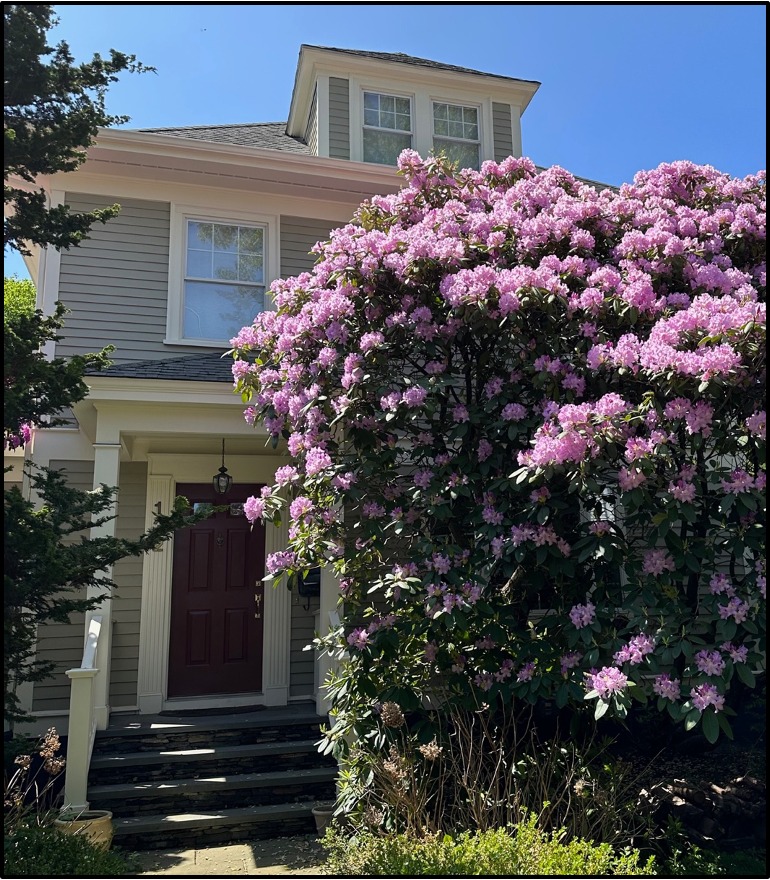
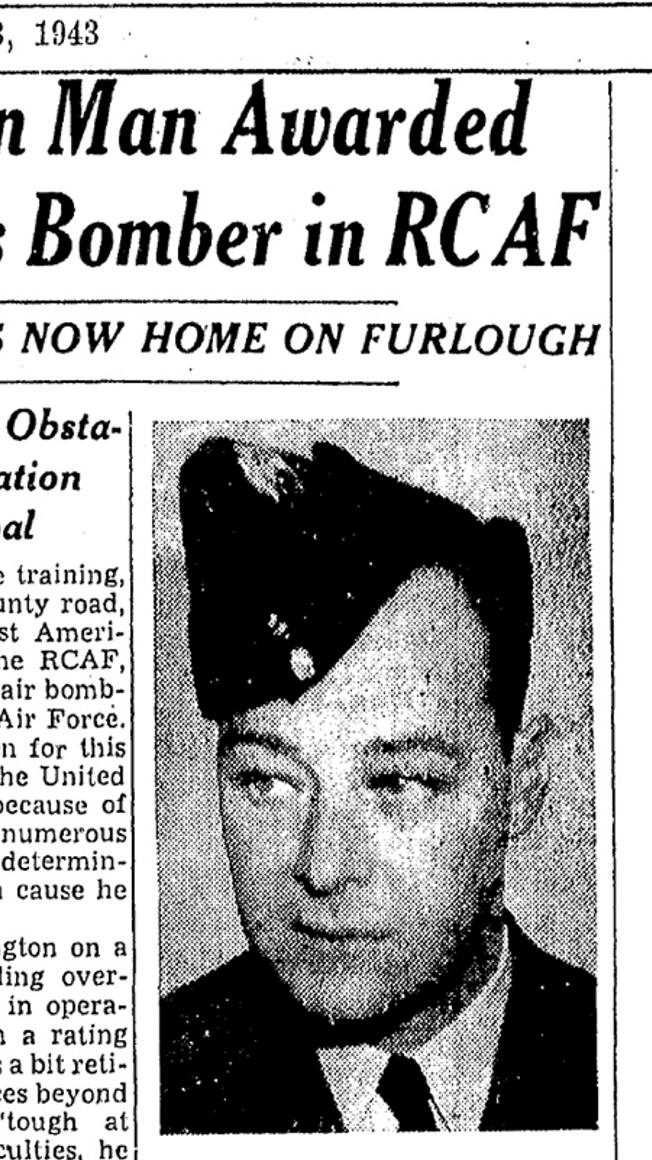
While preparing an architectural history presentation I am delivering for Barrington Preservation Society’s plaque program this week, I learned from my co-researcher on our plaque committee that this house we are studying was that of a bomber pilot killed in action in World War II (pictured; he lived there with his wife and mother-in-law, who was the owner).

A few years ago I had learned that my own house was the home of a young man killed in the Civil War. I have been doing house-history research for years, but don’t think I’ve either thought about or come across a term for this distinction for a house from which a resident was killed in military service: like a family’s service flag (the tradition, dating from World War I, of displaying a blue star for every family member in active service, and displaying a gold stars for a family member killed in service), but applying the concept to a house.

Without detracting from the greater importance of the concept to remember the families of fallen service members, it seems appropriate to make an effort to remember these Gold Star Houses, especially in communities—urban, suburban, or rural—where the neighborhood’s families may have all changed a generation later.

Two William Smiths, or, the decline of “junior”

Two adult William Smiths were living in Gloucester, Massachusetts, in 1775 and 1776. They were perhaps 12 years apart in age, and I have no evidence they were related. One of them—the older one—is my ancestor.

By 1775, the older colonial New England habit of distinguishing same-name men by “senior,” “junior,” “3rd,” etc., in order of their age, in public records was on its way to disappearing.  These two Williams are never distinguished in any town or civil records I’ve found: marriages, births of children, deeds, etc.

But I can be relatively sure* that “my” William Smith served in the Revolution.

How? Because they both enlisted in the same militia company in Gloucester in February 1776. “William Smith” and “William Smith junior” appear side by side in two muster rolls in that year.

Distinguishing them this way in the muster and pay rolls was contextually important. The older William left the unit on June 10, 1776, serving only 10 days in that quarter. William “junior” stayed in for several more months, but in the rolls drawn up in subsequent quarters, the clerk did not bother to call him “junior.” It wasn’t contextually necessary.

If the two Williams had not served together in the same unit, I would never have known for sure who was who, and that “my” William served for those four months.

*”relatively sure”: This of course depends on the argument from silence, that a third adult William Smith did not sojourn in Gloucester in 1776, or that this company, mustered and stationed at Gloucester, and looking, from its roster, like it included all Gloucester men, had no interlopers from other towns at this time.

Images: Capt. Daniel Giddings’s Co., Col. Joseph Foster’s Regiment, Coastal Defense [Mass. Militia], muster / pay rolls: Mass. State Archives, Revolutionary War Muster Roll Records Coll. (77 vols.), 36:13 (Feb., April, May 1776) and 36:48 (June, July, Aug. 1776) [FS DGS 008092197, images 28 and 43].